Showing posts with label gold coins. Show all posts

December 19, 2011

PILONCITOS: The treasure of Philippine numismatic


Piloncitos is the earliest form of precious metal based currency of the Philippines. It is likely made of pure gold with a weight ranging between .5 grams to more or less than 3 grams.

Piloncitos is not exclusively found in the Philippines as most collectors and local historians have agrees. Similar type of gold can be found in some regions of Indonesia which they call massa.

The earliest written account of Piloncitos was made by our national hero, Jose Rizal himself. According to Rizal, he found the gold nugget while tilling the soil of Dapitan. He himself coined the word piloncitos, which basically describe the coin's unusual shape. They are round and stamped with what looks like the pre-Spanish baybayin character “ma,” leading historians to guess that it could be short for “Ma-I.


Even before the Thai moved southward from their original home in China, the lucrative sea trade between the South China Sea and the Bay of Bengal established several maritime empires such as Sailendra-Srivijaya and Majapahit, which controlled coastal areas of modern Indonesia, Burma, Malaya, Thailand, Vietnam, and the Philippines.

In an era before coined money was widely used, Indo-Pacific beads were made first at a site called Aakmidu in South India ca. 200 BC. The manufacture then moved in sequence to Ceylon, South Thailand, Java and finally Malaya. By about 1200-1300 AD the larger Majopahit beads, excavated today in the interior of Java, had supplanted it. Since these factory sites have been dated, archaeologists now use the beads to date sites, though whether beads rose to the level of metals, salt, cloth, and cowries as "standard" trade goods is uncertain.

The first indigenous metallic coinage in the region, ca. 750-850 AD, comes from the Javanese kingdom of Sailendra (Chinese: Ho-ling). These roughly dome-shaped silver of irregular weight bore stamps of a flowing vase, and the sandalwood flower (quatefoil). By 850 AD weights had been standardized at 20 rattis to a Massa of about 2.4 grams. Silver and gold coins of Massa and fractional denominations were issued until about 1300 AD, with changes in shape and quality of inscription marking periods of issue. The gold Piloncitos of the Philippines are a late offshoot of the gold coinage, while the beanlike silver "namo" series, of the Malay isthmus was presumably an offshoot of the silver and may have evolved into the bullet (pod-duang) coinage of Sukothai
in Thailand.

Past local numismatist like Dra. Anita Legarda and Gilbert Perez made some research regarding this coin but only few specimen were found and no further study nor specimen have surfaced recently aside from those what have been found.

What fascinates historians and numismatists alike is why piloncito can only be found in the Philippines and unlike its counterpart gold massa that are vastly present in the Southeast Asian region.

February 19, 2011

PCGS Million Dollar Coin Club Now Includes 235 Coins Valued at $500+ Million

The second annual PCGS Million Dollar Coin Club reference guide has been unveiled by Professional Coin Grading Service (www.PCGS.com).

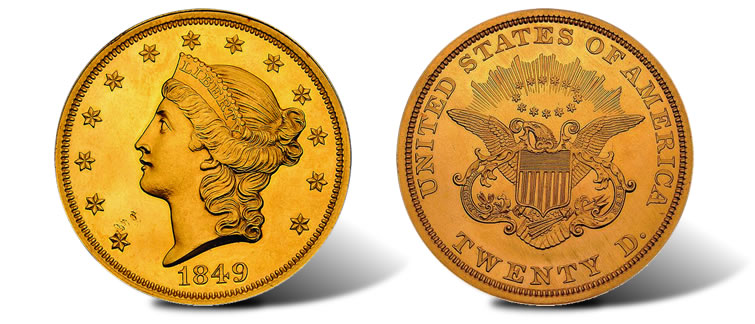
1849 Double Eagle

At an estimated $20 million, the historic 1849 Double Eagle is the highest valued coin in the 2011 list of the PCGS Million Dollar Coin Club. (Photo credit: Smithsonian's National Museum of American History.)

Originally launched in January 2010 with 210 "charter member" United States rare coins valued by experts at $1 million or more each, the "club" now has grown to include 235 coins with a combined value of over a half billion dollars. Some individual coins have jumped in estimated value as much as 50 percent the past year.

The complete Million Dollar Coin Club listing is available online at www.PCGS.com/Million-Dollar-Coin-Club.

"PCGS created the Million Dollar Coin Club a year ago for the benefit and enjoyment of collectors and dealers. It was just 15 years ago that a coin first broke the million dollar mark at auction, the Eliasberg specimen 1913 Liberty Head nickel that sold for $1,485,000 in 1996," said David Hall, President of Collectors Universe, Inc. (NASDAQ: CLCT) and Co-Founder of Professional Coin Grading Service (www.pcgs.com).

"We now estimate that there are 235 U.S. coins that already have sold for $1 million or more or would sell for $1 million or more if offered at auction. Our estimate for the total current value of all these coin rarities is $528,600,000! While not quite as thrilling as actual ownership, reading about and discussing these great numismatic treasures is a pleasure for all serious coin aficionados, and we certainly had a lot of fun putting this list together," said Hall.

Hall and Ron Guth, President of PCGS CoinFacts, compiled the list in consultation with four other well-known professional numismatists: Jim Halperin, Co-Chairman of Heritage Auctions, Dallas, Texas; Kevin Lipton, President of Kevin Lipton Rare Coins, Beverly Hills, California; Greg Rohan, President of Heritage Auctions; and Laura Sperber, President of Legend Numismatics, Lincroft, New Jersey.

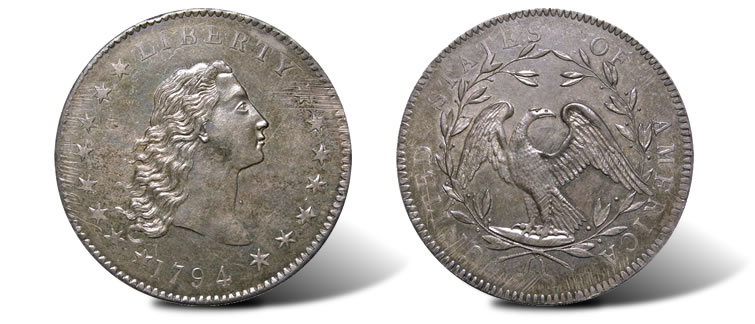
1794 Silver Dollar

The unique specimen strike 1794 dollar, graded PCGS SP66, is among the top ten in the 2011 list of the PCGS Million Dollar Coin Club. (Photo courtesy of Rare Coin Wholesalers.)

According to the PCGS expert team, here are the top ten most valuable coins struck by the United States Mint and their year-ago values if they changed:

1849 $20 Liberty (estimated PCGS grade PR64) — $20,000,000 (last year listed at $15,000,000). The first $20 gold piece struck at the United States Mint is part of the National Numismatic Collection at the Smithsonian’s National Museum of American History.

1907 Indian Head $20 Saint-Gaudens gold pattern (estimated PR69) — $15,000,000. Now in a private collection, this unique gold pattern was designed by famed sculptor, Augustus Saint-Gaudens, and combines his $10 Indian Head obverse design with his $20 reverse design.

1877 $50 gold pattern J-1546 (estimated PR67) — $15,000,000 ($10,000,000 last year). The famous "Half Union" gold piece is unique and in the Smithsonian.

1877 $50 gold pattern J-1548 (estimated PR67) — $15,000,000 ($10,000,000 last year). A variation on the design of the other "Half Union," this coin is also unique and in the Smithsonian.

1907 Double Thick Extremely High Relief Saint-Gaudens $20 (two coins, both estimated PR69) — $8,500,000 each. Arguably the most beautiful coin ever made, the Saint-Gaudens Double Eagle design was struck in several variations including two examples that are smaller in diameter and with double thickness. Both are in the Smithsonian.

1794 Silver Dollar (PCGS SP66) — $7,850,000 ($5,000,000 last year). This is believed by some to be the very first U.S. silver dollar struck.

1804 Class I ("Original") Silver Dollar (PCGS PR68) — $7,500,000. The finest of the famous 1804 silver dollars is the Sultan of Muscat-Virgil Brand-Walter Childs specimen now in a private collection.

1804 Class I ("Original") Silver Dollar (PCGS PR67) — $6,500,000. This is the coin that is part of the privately-owned King of Siam proof set.

1822 $5 gold piece (estimated EF45) — $6,000,000. The Eliasberg specimen now in another private collection is one of only three surviving 1922 Half Eagle gold coins out of 17,796 struck. The other two specimens are in the Smithsonian.

Although a 1933 Double Eagle (estimated MS65) sold at auction for $7,590,000 in 2002, the approximately 16 to 18 known examples are estimated at $2,500,000 to $3,500,000 because of uncertainty about the legality of private ownership of ten of them that are the subject of an ongoing lawsuit with the government. If the government wins and the ten coins it is now holding are not legal to own, then the value of the 1933 Double Eagles outside of government control would increase to well beyond $3,500,000, according to the PGCS experts.

High-quality images, experts’ narratives, pedigrees of the coins, rarity analysis, condition census and auction price histories for PCGS Million Dollar Coin Club "members" as well as thousands of other U.S. coins can be found online at PCGS CoinFacts (www.PCGSCoinFacts.com).

About PCGS

Professional Coin Grading ServiceProfessional Coin Grading Service (PCGS) is a division of Collectors Universe, Inc. (NASDAQ: CLCT), the leader in third-party authentication and grading services for high-value collectibles including rare coins, trading cards, tickets, autographs, memorabilia and stamps.

Since 1986, PCGS experts have authenticated, graded and certified more than 20 million coins from around the world with a declared value of over $20 billion.

For additional information, visit www.PCGS.com or call PCGS Customer Service at (800) 447-8848.

December 28, 2008

Philippine Bullion Report: Precious Metals alongside Energy & other Commodities Gain


Precious Metals: Gold, Silver, & Platinum

Precious metals and grains gain alongside energy prices last Friday trading, after a nine-day plunge in oil that shifted investors position to buy back into the ailing commodities market.

But so far, there is doubt that crude oil or other battered commodities are in for a consistent rebound. The labor market remains bleak, international trade is plummeting, and holiday retail sales were lower than forcasted. All these signs point to lower demand around the globe.

Gold has been performing better than other commodities. On Friday, gold for February delivery $23.00 to settle at $871.20 an ounce on the New York Mercantile Exchange (NYMEX).

Precious metals and grains gains alongside energy prices last Friday trading, after a nine-day plunge in oil that shifted investors position to buy back into the ailing commodities market.

But so far, there is doubt that crude oil or other battered commodities are in for a consistent rebound. The labor market remains bleak, international trade is plummeting, and holiday retail sales were lower than forcasted. All these signs point to lower demand around the globe.

Gold has been performing better than other commodities. On Friday, gold for February delivery $23.00 to settle at $871.20 an ounce on the New York Mercantile Exchange (NYMEX).

The precious metal is traditionally viewed as a safe investment in turbulent times. Its price plummeted as hedge funds and other large investors were forced to sell assets to raise cash, but the metal has been recovering from its mid-November lows as the economy and US dollar fall.

On Friday, the dollar slipped against the euro, but gained against the British pound.

Grain prices have also been advancing over the past few weeks on the Chicago Board of Trade, and extended their gains on Friday.

March wheat futures rose 17 cents to finish at $5.9925 a bushel, while March corn futures rose 14.25 cents to close at $3.98 a bushel. March soybeans rose 37.5 cents to settle at $9.565 a bushel.

Energy and industrial metals were not far behind. But they gained on Friday, despite news from Japan that industrial production sank by 8.1 percent in November — the worst monthly drop in more than 50 years.

Light, sweet crude for February delivery advanced $2.36, or more than 6 percent, to settle at $37.71 a barrel. US markets were closed on Thursday, and on Wednesday, crude prices had fallen for the ninth straight day.

In other Nymex trading Friday, gasoline futures rose 5.17 cents to settle at 88.4 cents a gallon, while heating oil rose 4.67 cents to settle at $1.245 a gallon.

March copper futures added 2.95 cents to close at $1.3035 a pound.

March silver gained 18 cents to close at $10.53 an ounce.


November 13, 2008

Ancient Celtic coin cache found in Netherlands


Celtic Stater Gold coin (late 1st century BC – early 1st century AD)

A hobbyist with a metal detector has found a cache of ancient Celtic and Germanic coins in a cornfield in the southern Dutch city of Maastricht.

The city says the trove of 39 gold and 70 silver coins are dated to the middle of the first century B.C. — around the time Julius Caesar was leading military campaigns in the region.

The hobbyist, Paul Curfs, found several coins this spring and called attention to the find, which eventually led to an archaeological investigation by Amsterdam's Free University.

Archaelogists believe the gold coins were minted by a local tribe called the Eburones that Caesar claimed to have wiped out. The silver coins were imported from Germanic tribes further north. Both have triple spirals on the front, a common Celtic symbol.- AP

November 12, 2008

Oil & Gas In A Special Coin

The Malampaya Commemorative Coin

The Malampaya Gas production rig located near Palawan is the of the country’s pride in energy independence. Brought by the surging cost in oil importation, refining, and distribution, several exploration attempts in the early 80’s and late 70’s confirmed that the nation has a potential source of natural gas and oil.

A study undertaken by University of the Philippines Professor Dante B. Canlas, the former chief of the National Economic and Development Authority (NEDA). Using natural gas royalties would cut power costs which may stimulate economic growth since it will make local industries more competitive.


The Electric Power Industry Reform Act (EPIRA) which indicates that royalties that could be collected from “the exploitation of all indigenous sources of energy including natural gas and geothermal steam" would be used to cut power costs. This will provide government additional tax and non-tax revenues, which would be more than sufficient to offset the foregone royalties collection. Thus, the project started and had been one of the top priorities of several administrations.

In October 16, 2001 Malampaya platform was formally inaugurated by the current president Gloria Arroyo and other local & foreign business figures. A special commemorative coin produced by the Central Bank Mint was issued to celebrate this special event. This coin weighs 16 grams and 32mm in size and is made out of .999 silver and plated with a 24 Karat gold. However, the mintage is deceptive since there was no official record on the mint, which indicated the number of coin produced. But what is certain that this were only given to officials who have attended Malampaya’s exclusive inauguration.

The special coin or more specifically, the special token comes with a wooden box with the emblem of Malampaya, which is otherwise featured, on the coin’s obverse. The existence of this special token has not been known until recently which concludes how few were produced for this exclusive event only.

November 11, 2008

Gold, Platinum Drop on Concern Recession May Lessen Demand on Metal


Gold futures fell on speculation a global recession will damp demand for precious metals and other raw materials. Platinum and silver also declined.

Equities in Asia, Europe and the U.S. fell today. More than $28 trillion in value has been erased from global equity markets this year as banks have posted more than $920 billion in credit losses and writedowns. The Reuters/Jefferies CRB Index of 19 raw materials is down by almost a third this year.

``We're back to focusing on the recession,'' said Leonard Kaplan, the president of Prospector Asset Management in Evanston, Illinois. ``You're seeing a bear market in everything. Gold traditionally does better than anything else in this recessionary environment, but it still goes down.''

Gold futures for December delivery fell $13.70, or 1.8 percent, to $732.80 an ounce on the Comex division of the New York Mercantile Exchange. The metal has dropped 29 percent from a record $1,033.90 in March.

Platinum futures for January delivery fell $33.30, or 3.9 percent, to $826.60 an ounce on the Nymex. The metal, used in jewelry and pollution-control devices in cars, has tumbled 64 percent from a record $2,308.80 on March 4.

Last week, General Motors Corp., the biggest U.S. automaker, reported a $4.2 billion third-quarter operating loss and warned it may run short of cash by the end of June. Ford Motor Co. reported a $2.98 billion loss in the quarter.

`Slammed'

``Nobody's going to buy cars,'' Kaplan said. ``You'll see platinum trade $100 to $250 lower than gold. It happens in every recession. Platinum is industrial, and catalytic converters and jewelry are going to get slammed.''

Platinum, palladium and silver have wider industrial uses than gold. Gold has dropped 13 percent this year. Silver is down 34 percent, and platinum and palladium has slumped more than 40 percent.

Gold may rebound to $800 in the next three months on investor demand for a haven from market turmoil, UBS AG analyst John Reade said.

``Interest in gold coins remains strong, with coin shortages apparent in many markets, while kilobars, one of the most popular investment categories, are trading at a high premium to the spot gold price due to long waiting lists at refineries,'' Reade said in a report.

A one-ounce Krugerrand coin from South Africa cost almost $37 more than the per-ounce spot price of gold today.

The U.S. Mint said this month it has resumed taking orders for American Buffalo 1-ounce gold-bullion coins after a surge in demand depleted supplies in its vaults.

Silver futures for December delivery fell 41.5 cents, or 4.1 percent, to $9.805 an ounce today on the Comex. Palladium for December delivery fell $2.75, or 1.2 percent, to $219.25 an ounce on the Nymex. - Bloomberg


next>>>


November 7, 2008

High-grade gold, silver found in S. Cotabato


A Canadian mining exploration company has found high-grade gold and silver deposits at a mining site in T’boli, South Cotabato.

Cadan Resources Corp., which operates the Tboli gold-silver project through Philippine affiliate Tribal Mining Corp., said the mine site might contain 584,000 tons of mineral deposits with 10.2 grams of gold and 50 grams of silver per ton.

In September, the company estimated mineral resources at the site at 420,000 ounces of gold and 1.6 million ounces of silver. It pegged the grade at 5.5 grams of gold and 21 grams of silver per ton.

"The latest higher grade results continue to indicate that the Tboli gold-silver resource not only appears to be larger in area. The grade also appears to be higher than [the earlier mineral resource classification]," Tribal Mining President Edgar D. Martinez said.

In a statement, he noted that there had been minimal surface exploration activity within a 400-meter area. Previous tests in the eastern side of the resource ranged from 13.37-81.14 grams of gold per ton, he added.

Tribal Mining obtained a permit to continue its exploration activities on Sept. 9 for potential development of the Tboli gold-silver project.

Canadian miner Cadan, which used to be known as Sur American Gold Corp., started underground development of the T’boli gold-silver deposits sometime later to determine the quality and quantity at the site.

The company’s mine development site straddles an area earlier contested by a native clan and a local cooperative.

The Maguan clan has sought clearance to mine the area of the T’boli Minahang Bayan Multipurpose Cooperative, which supposedly forms part of its ancestral domain claim. Consisting of small-scale mining operators, the cooperative has asked a local court that 21 hectares of a gold-rich portion of the village of Kematu in T’boli town be set aside for its exclusive use.

The land, however, forms part of the 85-hectare mining area granted by the government to Tribal Mining under a mineral production sharing deal.

Mines and Geosciences Bureau Regional Director Constancio A. Paye, Jr. said the dispute between the cooperative and Tribal Mining is separate from the claims of the Maguan clan.

Former South Cotabato Governor Hilario de Pedro III has issued an executive order apportioning the 21 hectares as the "people’s mining site" to address the row.

Mr. Paye said about 20 to 30 tunnels have been dug by cooperative members at the site over the years. — Romer S. Sarmiento, BsuinessWorld

 
© Copyright 2008 - 2013 www.filipinonumismatist.com