Showing posts with label rare coins. Show all posts

January 15, 2014

The 1894 One Centavo of Alfonso XIII


This very rare Spanish-Philippine coin was sold for 15, 500 euros as lot 1083 in the December auction of Cayon Numismatica and is considered as one of the most elusive coins of Philippine numismatic. The coins of one and two cents of weight, minted in Madrid at the hands of Bartolomé Maura, were made by order of 15 December 1893. The Decree refers to "lack of copper currency adjusted to the legal system" which encourages coining full retail. Shall be "the new pieces of copper one and two cents of weight, equivalent, as the silver 10 and 20 cents, which circulate in the Peninsula (...) Most all of these fractional coins will be legal tender only in the territories that are dependent on the General Government of the Philippines". The initiative was just one of the so many in the pipeline, but that Maura, the newly appointed general engraver, left us a few pieces by way of historical testimony. The magnificent bust with riotous hair, appears on these coins, still better than weight. It is perfectly proportioned (especially the two cents) and technically perfect.

It is especially curious that even having the permission of the Crown, coins on the same Islands were not coined under his name and it was even struck in Madrid, marked with a Pentagram. Perhaps because of insecurity or lack of larger machinery (remember the diameters of the cash of the father, 10, 20 and 50 cents, and clear, 4 weights) where carry out works such as these that we present. We assume that he just followed the guidelines given in the Royal Decree of December 15, 1893: "...Article 1. It is authorized the temporary opening of the Casa de Moneda de Manila, for the coinage which are necessary in the territories of the Government General of the Philippines, without prejudice of the Casa de Moneda de Madrid, to use when it's convenient to the best service..."and"...Section 3. This will be limited for now, fractional silver coin in 50, 20 and 10 cents of weight parts and bronze coin adjusted to the decimal system in parts one and 2 cents of weight..."

According to estimates, these coins exist only in two values, with no more than ten or twelve mintages. Preserves the archaeological museum in Madrid two parts of a penny and three two (one of them Sastre collection proceeding).  These coin has never been in the market in the last decade and was only recorded sold in the Philippines once decades ago.

August 15, 2013

1762 One Real with F70 counterstamp: A Unique Specimen Of Counterstamped Minor Coins

Counterstamped minor coin is one of the hardest to acquire in the hobby of collecting counterstamp coins.  Dr. Pablo De Jesus and Dr. Fortirch have listed counterstamped minor coins among the top variety of counterstamp coins that are hard to come by in the market.  Among the four (4) denominations other than 8 reales, only three (3) namely: four (4) reales, two (2) reales, and one (1) real counterstamped coins have appeared in the market since the collecting began in the early days of the 20th century in the Philippines.  Among them, only the four (4) and two (2) reales have been documented to bear both King Ferdinand VII and Queen Isabela II mark while only specimen bearing the counterstamp of Queen isabela II appeared in the one (1) real coin.  No half (1/2) real coin was known to exist bearing either of the two reigns.

Among the counterstamped one real coins, none were struck on coins dating the 1700 period and those that were reported to surface only bear the reign mark of Queen Isabela II.  Very rare are the "dos mondos" or the legendary two pillar coins having marks of either of the two reign in any denominations.  Seeing a one real "dos mondos" bearing the mark of King Ferdinand VII is really magnificent and breathtaking because this is truly another great discovery in the realm of Philippine numismatic.  The specimen bears the 5-4-1 pearl and  minted in Mexico.    

April 21, 2011

Holy Week Special: The Sacred Money Part II

Holy week or “Mahal na Araw” as we call it, is a very special occasion among Filipino Christians as we recall and dramatize the crucifixion of Jesus Christ. Among the traditions that we inherited from the Spaniards is the “pabasa” as a unique practice among the local Christians where the “Passion of Christ” is sang rather than read for the whole day within a week. Famous it is that even our colonizer admires such practice.

This is also a special occasion among the practitioners of witchcraft, faith healing, and holders of talisman as they re-energized their powers and learn more from their peers thru gatherings or conventions that are especially held every Good Friday of the Lenten season. As a numismatist and historian, talisman or anting-anting amulet never fails to amaze me because of its uniqueness and the mystery behind.

The Sacred Money or Agimat is a very unique aspect of numismatic that can only be found in the Philippines. Mostly either made or casted in bronze and brass, and rarely in silver or other precious metals, these amulets mostly appeared during the period of revolution from Spain and Philippine-American War.

Among the amulets, the silver amulets and those made with other precious metals baffle historians and numismatic researchers alike because it appeared from nowhere and neither without recognizable purpose except that it depicts face value in peso. Studying historical records, the denomination was first introduced in the Philippines during the later reign of Queen Isabela II of Spain and it was first introduced in the form of Gold. The “Un Peso” denomination became acceptable in silver as Spain slid in political and economic turmoil during the reign of Alfonso XIII when the one year type “Un Peso” dated 1897 reached the Philippines during the last years of Spain in the colony. Therefore, we know for a fact that these amulets as most historians agree were first struck during that same period.

Some numismatists and local coin dealers suspect that most of these amulets were manufactured in the Southern Tagalog region particularly in Batangas were there were many silver smiths during that period and some even argue that it was minted by several Masonic organizations to commemorate or celebrate an important event. But why most of these bear the dates of 1001, 1770, and 1771?

The date 1001 is particularly significant with the Moslems and not with the Christians particularly made famous by the story “The Arabian Nights”. Meanwhile, the date 1771 was not technically the last minting of the famous coinage “dos mondos” and in relation to the country’s history does not connect to any memorable event of the same year.

In mathematical analysis, 1001 is the first and equal symmetrical number with equal number “1” and “0”. We can even see a distinctive "personality" in these various kinds of number behavior complementing three personality groupings.

The vertical type (based on unconscious specialisation of personality) complements the difference (i.e. of given number and reverse) which is always divisible by 9 (i.e. in base 10).

The horizontal type (based on conscious specialization of personality) complements the sum (i.e. of given number and reverse with even total of digits) which is always divisible by 11.

The diagonal type (based on both conscious and unconscious specialization of personality) complements the difference (i.e. of given number and odd total of digits) which is always divisible by 99.

That will point us to the Holy Family or Sagrada Familia which is always placed either on the reverse of the 1001 or above it. The 1001 therefore is not a date but a representation of psychological and personality perfection.

There are also numerous symbols included in the medal that are foreign in origin like the crossed keys which is the symbol of the Vatican, the Sun’s face which can be found on the coinage of South and Central America like the Rio Plata of Colombia, the crossed-wing Eagle with a snake which is from Mexico, and the Cap and Rays which is also from the same region.

New findings also suggest that these medals / coins were not defaced 8 reales or USPI peso but made and struck out of several distinct dies as suggested by their weights and dimensions. Most of them weighs between 30 to almost 40 grams with measurement ranging from 35 to 42 millimeter making me suspicious otherwise that these amulets were struck using not only of silver but a combination of gold and silver that could have made it heavier than coins of the same size. (to be continued)

March 8, 2011

Stack’s Bowers Galleries 2011 Baltimore Auction Features 5,100+ US Coin, Currency and Exonumia Lots

Stack’s Bowers Galleries will conduct the official auction of the March 2011 Whitman Coin & Collectibles Baltimore Expo. The premiere event conducted under the Stack’s Bowers Galleries banner by the newly merged Stack’s and Bowers and Merena Auctions, the March 2011 Baltimore Auction continues the tradition and success of America’s most prestigious numismatic auctioneers.

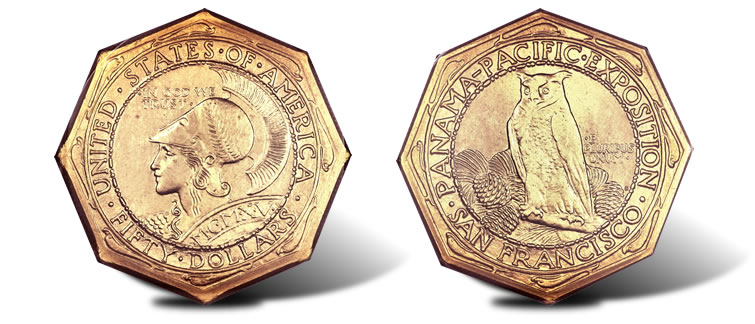
1915-S Panama-Pacific Exposition $50 Octagonal and Round

The 1915-S Panama-Pacific Exposition $50 Octagonal, MS-64 (PCGS) and 1915-S Panama-Pacific Exposition $50 Round, MS-63 (PCGS) are two of many highlights in Stack's Bowers Galleries 2011 Baltimore Auction which features more than 5,100 US coin, currency and exonumia lots

The Stack’s Bowers Galleries March 2011 Baltimore Auction will feature 7,690 total lots, including nearly 4,250 lots of U.S. coins and exonumia and an additional 850+ lots of U.S. currency.

Lot viewing will be conducted by appointment at the firm’s Irvine, California, headquarters March 8-15, at the firm’s New York office March 21-23, and onsite at the Baltimore Convention Center March 28-April 1. The auction will be held at the Baltimore Convention Center beginning Tuesday, March 29, concluding Friday, April 1, and will present four U.S. coin sessions, one U.S. currency session, and three foreign coin and paper money sessions.

According to Stack’s Bowers Galleries president Chris Napolitano:

"Our official auction of the March 2011 Baltimore Expo will present a diverse and exciting array of U.S. coins, currency and exonumia. From historic Betts Medals, to premium-quality ‘collector coins’ in old PCGS and NGC holders, to world-renowned rarities such as early United States Mint proof coinage and matte proof gold, our March Baltimore Auction offers something for everyone."

Anchoring the March 2011 Baltimore Auction are several fresh consignments featuring coins that have been off the market for many years, in some cases decades. The Dr. Albert R. Frederick, Jr. Collection was formed over a period of many years by a New England collector working closely with Q. David Bowers and Ray Merena, and it features a wide variety of classic United States coins.

The Glenwick Family Collection is also fresh to market and features newly certified classic gold coins, silver and gold Commemoratives and other issues. Certified by PCGS and NGC in "old holders," The Denny Kemp Collection represents a cherrypicker’s dream with many examples conservatively graded by current market standards. The quality and appeal of the Denny Kemp Collection is such that nearly 90 percent of the coins in this collection have been stickered by CAC.

Other important offerings in the March 2011 Baltimore Auction include a selection of New Orleans Mint Eagles from The David Solomon Collection, an impressive array of California Fractional gold coins from The Eleanor C. Paradee Collection – many examples also pedigreed to the famous Jay Roe Collection – and an incredible offering of Panama-Pacific Exposition Commemorative $50 gold coins in octagonal and round formats. Both Pan-Pac $50 gold pieces were acquired at the Panama-Pacific Exposition in 1915 and passed down through the same family until their presentation in this auction.

U.S. coin and exonumia highlights of the Stack’s Bowers Galleries Official March 2011 Baltimore Auction include:

  • "1781" (1782) Libertas Americana Medal, Betts-615, Silver, AU-55 (PCGS)
  • 1831 Classic Half Cent, B-2, First Restrike, Proof-66 BN (PCGS), CAC
  • 1793 Chain Cent, S-3, AMERICA, No Periods, EF-40 (PCGS), Secure Holder
  • 1793 Wreath Cent, S-8, Vine and Bars Edge, MS-64 BN (PCGS)
  • 1799 Draped Bust Cent, S-189, VF-30 (PCGS), CAC
  • 1831 Capped Bust Half Dollar, O-102, MS-67 (PCGS)
  • 1836/1336 Capped Bust Half Dollar, Lettered Edge, O-108, Proof-64 Cameo (PCGS)
  • 1836 Capped Bust Half Dollar, Lettered Edge, O-116, 50/00, Proof-64 (PCGS), CAC
  • 1799 Draped Bust Silver Dollar, B-5, MS-62 (PCGS), CAC
  • 1839 Gobrecht Silver Dollar, Name Omitted, Judd-104 Restrike, Proof-65 (NGC)
  • 1852 Seated Liberty Silver Dollar, Restrike, Proof-65 (NGC)
  • 1894 Morgan Silver Dollar, MS-65 (PCGS), CAC, OGH, From the Denny Kemp Collection
  • 1848 Liberty Quarter Eagle, CAL., EF-45 (PCGS)
  • 1885 Three-Dollar Gold Piece, Proof-67 Cameo (NGC), CAC
  • 1837 Classic Half Eagle, MS-66 (NGC)
  • 1909-S Indian Half Eagle, MS-65 (PCGS), CAC, OGH
  • 1803 Capped Bust Right Eagle, Small-Stars Reverse, MS-63 (PCGS), OGH, From the Dr. Albert R. Frederick, Jr. Collection
  • 1883-O Liberty Eagle, AU-53 (NGC), From the David Solomon Collection
  • 1908 Saint-Gaudens Double Eagle, Motto, Proof-66 (NGC)
  • 1912 Saint-Gaudens Double Eagle, Proof-67 (NGC)
  • 1927-S Saint-Gaudens Double Eagle, MS-63 (PCGS)
  • 1915-S Panama-Pacific Exposition $50 Octagonal, MS-64 (PCGS)
  • 1915-S Panama-Pacific Exposition $50 Round, MS-63 (PCGS)
  • 1880 Pattern Four-Dollar Stella, Coiled Hair, Judd-1661, Proof-64 RB (PCGS)
  • 1854-FD Round $1, BG-602, Rarity-6+, AU-50 (PCGS), From the Eleanor C. Paradee Collection

U.S. currency highlights of the Stack’s Bowers Galleries Official March 2011 Baltimore Auction include:

  • Lockport, New York, Niagara County Bank, 1.7.1856, $2, Proof, Choice Uncirculated, NY-1255G4a
  • Lockport, New York, Niagara County Bank, 1.7.1856, $3, Proof, Choice Uncirculated, NY-1255G6a
  • Fr. 126b, 1863 $20 Legal Tender, Gem New 65 PPQ (PCGS)
  • Fr. 757, 1918 $2 Federal Reserve Bank Note, Choice Uncirculated 64 (PMG), Serial Number D1A
  • Fr. 372, 1890 $20 Treasury Note, Extremely Fine 40 (PMG), Serial Number A4
  • Fr. 1850-I, 1929 $5 Federal Reserve Bank Note, Gem Uncirculated 65 EPQ (PMG)
  • Fr. 1190, 1882 $50 Gold Certificate, Fine 15 (PCGS)
  • Frankford, Delaware, $20 1902 PB, Fr. 652, The First NB, Charter #8918, Very Fine 25 (PMG)
  • Fr. 2231-B, 1934 $10,000 Federal Reserve Note, Uncirculated 62 (PMG)
  • Fr. 311, 1880 $20 Silver Certificate, Very Fine 30 (PCGS)
  • Fr. 2407, 1928 $500 Gold Certificate, Very Fine 35 (PCGS)
  • Fr. T-2, 1861, $500, About New 50 PPQ (PCGS)

All lot descriptions and images in the March 2011 Baltimore Auction can be viewed online at the Stack’s Bowers Galleries website, www.stacksbowers.com. Printed catalogs are available upon request by calling 800.458.4646. Online bidding will commence in early March and pre-auction bids will be accepted at www.stacksbowers.com; by e-mail at auction@stacksbowers.com; by phone at 800.458.4646; by fax at 949.253.4091; and by postal mail addressed to Stack’s Bowers Galleries, Baltimore March 2011, 18061 Fitch, Irvine, CA, 92614.

Interested bidders are also encouraged to view lots onsite in Baltimore in March and bid in-person at the live auction, or live online through the Stack’s Bowers Galleries. A complete auction and lot viewing schedule is available at www.stacksbowers.com or by calling 800.458.4646.

About Stack’s Bowers Galleries

Stack’s Bowers Galleries, a division of Fortune 500 Company Spectrum Group International Inc., was launched in January 2011, combining the extraordinary histories of Stack’s, the oldest rare coin auction and retail company in America, with Bowers and Merena Auctions, one of the world’s pre-eminent auctioneers of rare coins and paper money.

The two companies unite to share a combined legacy that spans more than 100 years, and includes the cataloging and sale of many of the most valuable collections to ever cross an auction block – the John. J. Ford, Jr. and Louis E. Eliasberg collections, the Harry W. Bass, Jr. Collection, and the Norweb Collection, to name just a few.

Topping off this amazing numismatic history is the inclusion of the world record for the highest price ever realized at auction for a rare coin, the legendary 1933 St. Gaudens Double Eagle which realized an astounding $7.59 million (sold in partnership with Sotheby’s). The company is headquartered in Irvine, California, with offices in New York and New Hampshire.

Stack’s Bowers Galleries is the Official Auctioneer for several important numismatic conventions, including the ANA World’s Fair of Money pre-show and convention auctions, and the Whitman Coin and Collectibles Expos in Baltimore, three times yearly, and Philadelphia.


February 19, 2011

PCGS Million Dollar Coin Club Now Includes 235 Coins Valued at $500+ Million

The second annual PCGS Million Dollar Coin Club reference guide has been unveiled by Professional Coin Grading Service (www.PCGS.com).

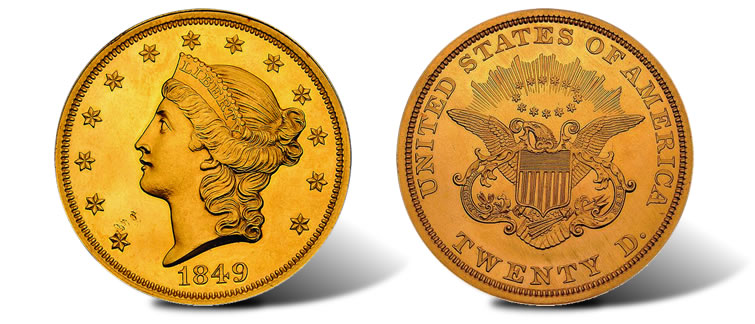
1849 Double Eagle

At an estimated $20 million, the historic 1849 Double Eagle is the highest valued coin in the 2011 list of the PCGS Million Dollar Coin Club. (Photo credit: Smithsonian's National Museum of American History.)

Originally launched in January 2010 with 210 "charter member" United States rare coins valued by experts at $1 million or more each, the "club" now has grown to include 235 coins with a combined value of over a half billion dollars. Some individual coins have jumped in estimated value as much as 50 percent the past year.

The complete Million Dollar Coin Club listing is available online at www.PCGS.com/Million-Dollar-Coin-Club.

"PCGS created the Million Dollar Coin Club a year ago for the benefit and enjoyment of collectors and dealers. It was just 15 years ago that a coin first broke the million dollar mark at auction, the Eliasberg specimen 1913 Liberty Head nickel that sold for $1,485,000 in 1996," said David Hall, President of Collectors Universe, Inc. (NASDAQ: CLCT) and Co-Founder of Professional Coin Grading Service (www.pcgs.com).

"We now estimate that there are 235 U.S. coins that already have sold for $1 million or more or would sell for $1 million or more if offered at auction. Our estimate for the total current value of all these coin rarities is $528,600,000! While not quite as thrilling as actual ownership, reading about and discussing these great numismatic treasures is a pleasure for all serious coin aficionados, and we certainly had a lot of fun putting this list together," said Hall.

Hall and Ron Guth, President of PCGS CoinFacts, compiled the list in consultation with four other well-known professional numismatists: Jim Halperin, Co-Chairman of Heritage Auctions, Dallas, Texas; Kevin Lipton, President of Kevin Lipton Rare Coins, Beverly Hills, California; Greg Rohan, President of Heritage Auctions; and Laura Sperber, President of Legend Numismatics, Lincroft, New Jersey.

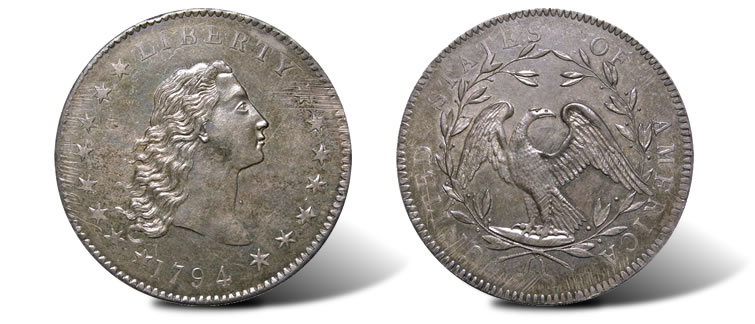
1794 Silver Dollar

The unique specimen strike 1794 dollar, graded PCGS SP66, is among the top ten in the 2011 list of the PCGS Million Dollar Coin Club. (Photo courtesy of Rare Coin Wholesalers.)

According to the PCGS expert team, here are the top ten most valuable coins struck by the United States Mint and their year-ago values if they changed:

1849 $20 Liberty (estimated PCGS grade PR64) — $20,000,000 (last year listed at $15,000,000). The first $20 gold piece struck at the United States Mint is part of the National Numismatic Collection at the Smithsonian’s National Museum of American History.

1907 Indian Head $20 Saint-Gaudens gold pattern (estimated PR69) — $15,000,000. Now in a private collection, this unique gold pattern was designed by famed sculptor, Augustus Saint-Gaudens, and combines his $10 Indian Head obverse design with his $20 reverse design.

1877 $50 gold pattern J-1546 (estimated PR67) — $15,000,000 ($10,000,000 last year). The famous "Half Union" gold piece is unique and in the Smithsonian.

1877 $50 gold pattern J-1548 (estimated PR67) — $15,000,000 ($10,000,000 last year). A variation on the design of the other "Half Union," this coin is also unique and in the Smithsonian.

1907 Double Thick Extremely High Relief Saint-Gaudens $20 (two coins, both estimated PR69) — $8,500,000 each. Arguably the most beautiful coin ever made, the Saint-Gaudens Double Eagle design was struck in several variations including two examples that are smaller in diameter and with double thickness. Both are in the Smithsonian.

1794 Silver Dollar (PCGS SP66) — $7,850,000 ($5,000,000 last year). This is believed by some to be the very first U.S. silver dollar struck.

1804 Class I ("Original") Silver Dollar (PCGS PR68) — $7,500,000. The finest of the famous 1804 silver dollars is the Sultan of Muscat-Virgil Brand-Walter Childs specimen now in a private collection.

1804 Class I ("Original") Silver Dollar (PCGS PR67) — $6,500,000. This is the coin that is part of the privately-owned King of Siam proof set.

1822 $5 gold piece (estimated EF45) — $6,000,000. The Eliasberg specimen now in another private collection is one of only three surviving 1922 Half Eagle gold coins out of 17,796 struck. The other two specimens are in the Smithsonian.

Although a 1933 Double Eagle (estimated MS65) sold at auction for $7,590,000 in 2002, the approximately 16 to 18 known examples are estimated at $2,500,000 to $3,500,000 because of uncertainty about the legality of private ownership of ten of them that are the subject of an ongoing lawsuit with the government. If the government wins and the ten coins it is now holding are not legal to own, then the value of the 1933 Double Eagles outside of government control would increase to well beyond $3,500,000, according to the PGCS experts.

High-quality images, experts’ narratives, pedigrees of the coins, rarity analysis, condition census and auction price histories for PCGS Million Dollar Coin Club "members" as well as thousands of other U.S. coins can be found online at PCGS CoinFacts (www.PCGSCoinFacts.com).

About PCGS

Professional Coin Grading ServiceProfessional Coin Grading Service (PCGS) is a division of Collectors Universe, Inc. (NASDAQ: CLCT), the leader in third-party authentication and grading services for high-value collectibles including rare coins, trading cards, tickets, autographs, memorabilia and stamps.

Since 1986, PCGS experts have authenticated, graded and certified more than 20 million coins from around the world with a declared value of over $20 billion.

For additional information, visit www.PCGS.com or call PCGS Customer Service at (800) 447-8848.

February 16, 2011

Heritage February 2011 Long Beach US Coin Auction Realizes $8.596M

Collectors put particular emphasis on acquiring high-grade Saint-Gaudens coinage in Heritage’s $8.596 million Long Beach Signature® U.S. Coin Auction, February 5-6, 2011, at the Long Beach Convention Center.

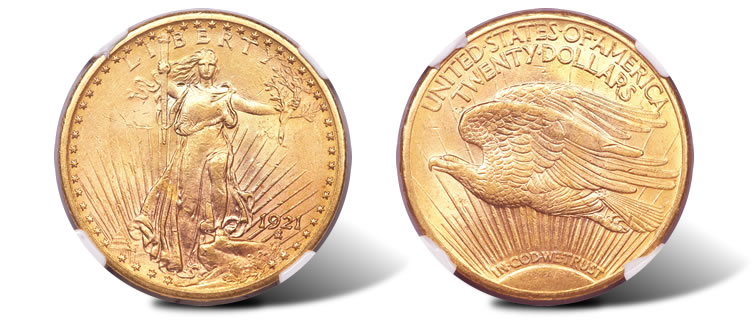
1921 Saint-Gaudens $20 MS62 NGC

This 1921 Saint-Gaudens $20 MS62 NGC realized $126,500 at the Heritage February 2011 Long Beach US Coin Auction.

The auction saw a 94% sell-through rate by value and 97% sell-through rate by lot. All prices below include 15% Buyer’s Premium.

"I think steady and solid is the best way to categorize the results," said Greg Rohan, President of Heritage Auctions. "Not spectacular, but about what we expected, with a little more on top. Certainly gold continued to be the chief consideration for high-end buyers."

A 1921 Saint-Gaudens $20 MS62 NGC, the second rarest series issue in high grades, was the top lot of the auction, with collectors bidding the coin all the way up to $126,500. The coin is one of very few known and, as stated in the 2008 second edition of the David Akers Handbook of 20th Century United States Gold Coins, 1921 Saint-Gaudens $20s "that grade MS-63 or finer are offered only once in a very long while."

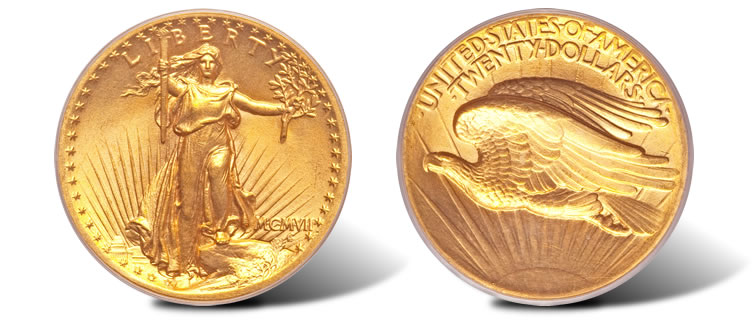
1907 $20 High Relief, Flat Rim

This 1907 $20 High Relief shows Augustus Saint-Gaudens' design before Charles Barber made several drastic changes. Unsurprisingly, when Theodore Roosevelt chose Saint-Gaudens to begin the redesign of American coinage, he offended Barber, who was chief engraver at the mint. It realized $97,750.

A Premium Gem 1907 $20 High Relief, Flat Rim MS66 PCGS, one of the most highly sought-after of the High Relief Saint-Gaudens varieties, was the second highest lot in the auction, challenging the six figure mark, but coming up just short, as it finished the auction at $97,750. This coin is remarkable for many reasons, not the least of which is that it purely represents the original designs of Augustus Saint-Gaudens, before his death in 1907, and the subsequent changes to his designs, made by longtime rival Samuel Barber, which appeared on future gold coinage.

1915-S Panama-Pacific $50 Octagonal

This 1915-S Panama-Pacific $50 Octagonal realized $86,250 at the Heritage February 2011 Long Beach US Coin Auction. The fifty dollar octagonal Pan-Pac coins remain today the only octagonal coins ever issued by the U.S. Mint, and both they and their round siblings are hotly contested in any grade at auction.

Always a highly anticipated event when they turn up at auction, a 1915-S $50 Panama-Pacific Octagonal MS63 PCGS, the last and greatest coin in an original four-piece commemorative set, lived up to the billing by bringing $86,250, amid spirited bidding, to round out the top trio of the Heritage Long Beach event.

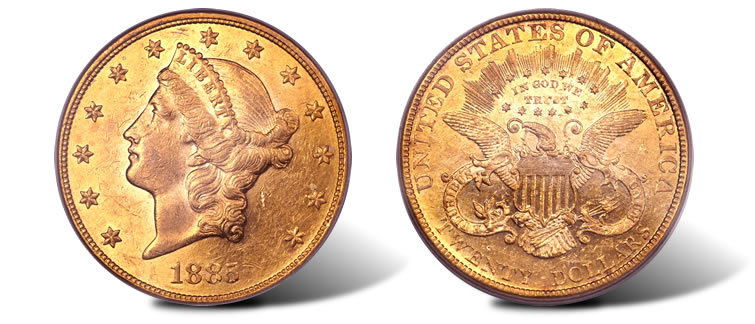
1885 Liberty Head $20

This 1885 Liberty Head $20 realized $80,500 at the Heritage February 2011 Long Beach US Coin Auction. In 1885, the Philadelphia Mint coined a meager 828 double eagles, a figure that includes 77 proof examples. The business-strike mintage of 751 pieces ranks among the lowest production totals in the entire regular-issue series of U.S. gold coinage.

A classic gold rarity, in the form of an 1885 $20 MS61 PCGS, CAC, one of only 751 pieces struck – ranking among the lowest production totals in the entire regular-issue series of U.S. gold coinage – realized $80,500, while a 1920-S $20 MS62 PCGS, CAC, among the most elusive in the Saint-Gaudens series, realized $80,500.

Further highlights include, but are not limited to:

  • 1879-CC $5 MS62 PCGS. CAC: Realized: $69,000.
  • 1860 $3 PR66 Cameo NGC: Realized: $66,125.
  • 1908 $20 Motto PR66 NGC: Realized: $60,375.
  • 1920-S $20 MS62 NGC: Realized: $54,625.
  • 1895 $1 PR64 Cameo PCGS: Realized: $54,625.

April 29, 2009

Rare coin could get more than $2M at an auction

coin
CINCINNATI – The coin world is abuzz over the auction of a rare silver dollar, one of the most valuable in the world and one of only 15 known to exist from a never-circulated group made for the likes of the King of Siam and the Sultan of Muscat.

The 1804 Adams-Carter silver dollar fetched more than $2 million in a private sale two years ago and is expected to top that again this week. The coin has been owned by a Boston banker, a Texas publishing mogul and by a collector who sold everything to help build a church school in Ohio.

The auction is a major happening for collectors — even ones who can't afford the expected price tag — partly because it will be a rare opportunity to see the coin. It's the highlight of the Central States Numismatic Society Convention that runs Wednesday through Saturday in Cincinnati. Anyone registered to bid on any item in the auction may view the coin, and that could number in the thousands, said Todd Imhof of Heritage Auction Galleries of Dallas.

Joe Barrett, co-owner of three Rare Coin Gallery shops in the Cincinnati area, compared the convention to a movie buff's visit to a film museum, with Kevin Costner as tour guide.

"For coin people, it doesn't get any better than this," Barrett said. "For young collectors, this is an opportunity to see things they wouldn't get a chance to see otherwise."

Beth Deisher, editor of Coin World magazine, suggested the valuable coin may not be seen in public for another 50 years.

"It's a rare coin that has a great story," she said.

Coin Values magazine rates the 1804 Adams-Carter silver dollar as the seventh most valuable coin in the world. The most valuable is a 1933 $20 double eagle that sold for $7.6 million in 2002.

Only 15 of the 1804 silver dollars are known to have been struck, and coin aficionados can account for every one of them. Six are held by museums.

The coins were never circulated and weren't actually struck in 1804 — the date refers to the year after the US Mint stopped making silver dollars. The front of the coin shows a bust of Lady Liberty in profile, the reverse a version of the Great Seal of the United States.

Coin Facts says eight of the coins were ordered struck by the US Department of State in 1834 to be given to foreign heads of state, including the King of Siam and the Sultan of Muscat. One specimen was made in 1857. The other six, including the Adams-Carter dollar, were made sometime after that — possibly illegally by a mint employee.

The one being auctioned Thursday is named for 19th century collector Phineas Adams, an early owner, and Amon Carter Sr., a later owner, Texas oilman, entrepreneur and publisher of the Fort Worth Star-Telegram.

In November 2001, Phillip Flannagan donated the coin to raise money for the building fund at Middletown Christian School, north of Cincinnati. It brought $874,000 at auction. The rest of Flannagan's collection, totaling some $2 million, went to Grace Baptist Church, which operates the school.

The name of the current owner is closely guarded. Heritage Auction Galleries identifies him only as an East Coast collector. The buyer mostly likely will bid through an agent.

Internet bidding will continue until two hours before Thursday night's auction, Imhof said. The high bid on Tuesday had reached $1.7 million. The live auction, expected about 9:30 p.m. EDT Thursday, will be streamed on Heritage's Web site, Imhof said. - AP
 
© Copyright 2008 - 2013 www.filipinonumismatist.com